aifantry
Back to Case Studies

Building an AI Fitness Coaching Platform: The MintFit Story

How we built MintFit — an AI coaching platform for a specialist 50+ training studio. RAG pipeline, LangChain, AWS Amplify, and what made it genuinely hard.

Project Duration:5 months
Industry:Healthcare
Published:May 19, 2026
Tools Used
  • Next.js 14
  • React 18
  • AWS Amplify
  • AWS Cognito
  • Amazon S3
  • OpenAI
  • LangChain
  • LangGraph
  • Zustand
  • TanStack Query
  • Recharts
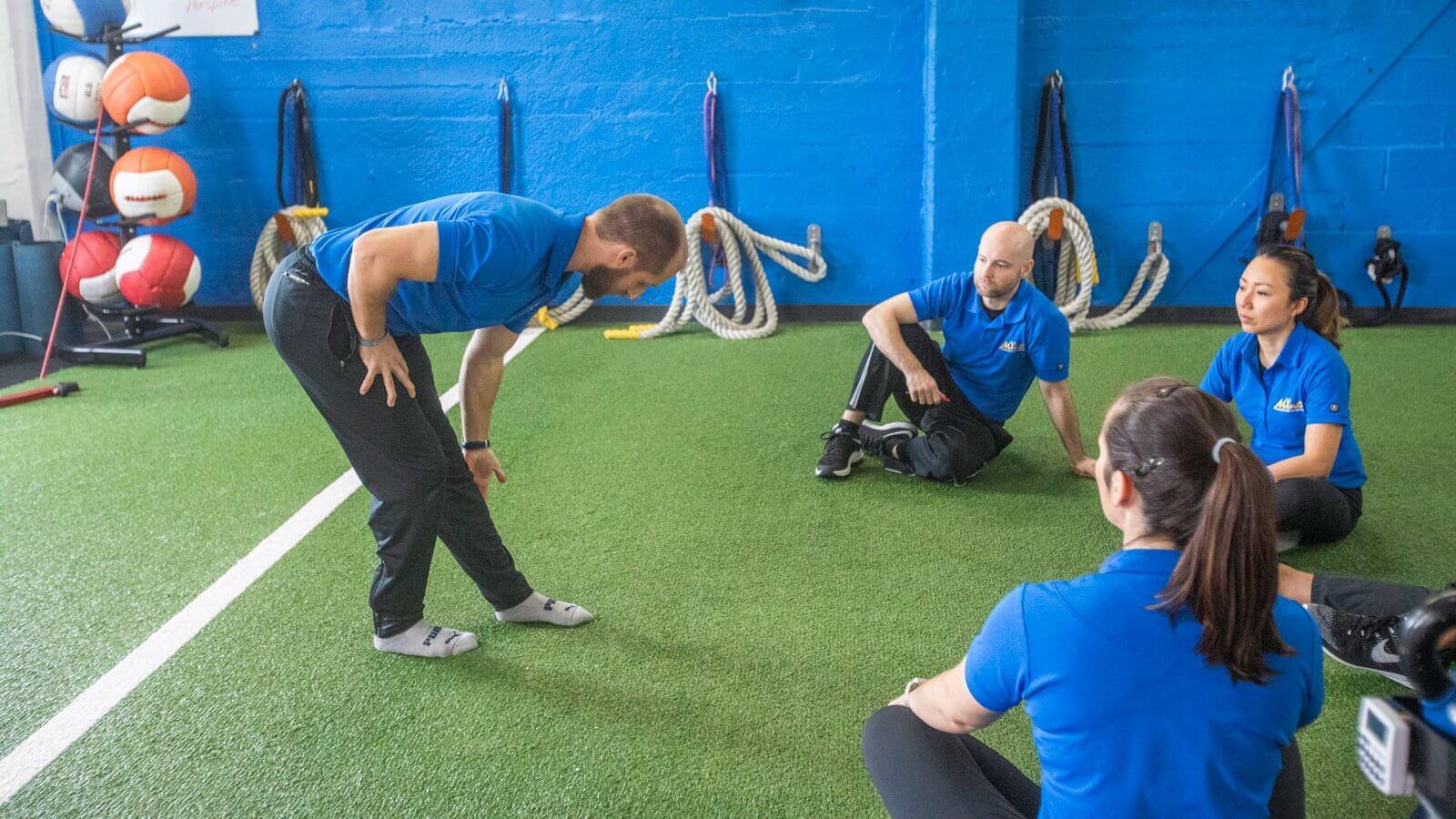
Mint Condition Fitness Featured Image

Six weeks after we shipped the program generator, Colin Triplett — founder of Mint Condition Fitness — came back with feedback I wasn't expecting. His coaches weren't using the AI-generated programs. Not because the exercises were wrong. The structure was sound, the sequence made sense. But the AI was writing "Romanian Deadlift" when every coach at Mint Condition Fitness writes "SB RDL @2011 x8". Fifteen years of proprietary shorthand — equipment codes, tempo notation, protocol abbreviations — had been embedded as noise.

That's the problem with building AI for specialist operations. Generic fitness knowledge is everywhere. The thing that makes a coaching business valuable — the accumulated conventions, the proprietary structure, the way coaches write a session — isn't in any training dataset. You have to engineer for it deliberately. This is what that looks like.

Who Mint Condition Fitness Are

Mint Condition Fitness is the number one rated strength and longevity studio in Los Gatos, California, serving adults aged 50 and above. Founded in 2009 by Colin Triplett, the studio operates on a methodology called the Thrive50+ Method: personal training, health and fitness testing, nutrition coaching, and recovery services — built entirely around the physiological realities of ageing.

That means every client engagement is structured around detailed assessments, injury history, movement quality, pain clearance, and long-term progression tracking. The studio's value is in the depth and consistency of that process. It's also what makes software for MintFit distinctly harder than building for a standard gym.

The Problem

As Mint Condition Fitness grew, the coaching team hit an operational ceiling familiar to any service business that runs on accumulated expert knowledge.

Client data was fragmented. Assessment records, coaching notes, historical programs, and health history lived in separate places. When a coach picked up a new client, or returned to one after a gap, reconstructing a complete picture required significant manual effort — effort that came directly out of coaching time.

Program creation was slow. Building a plan from scratch for a client with complex history took 30 to 60 minutes. Not because the coaches weren't skilled — because the process required mentally integrating assessment history, movement constraints, past programming, and studio conventions before writing a single exercise.

New coach onboarding was harder than it should have been. The Thrive50+ Method has specific naming conventions, exercise sequences, and programming rules. That knowledge existed in documents and in senior coaches' heads. It wasn't encoded anywhere a system could use.

The brief: build a single platform that unified these workflows, with AI that understood the client and the methodology — not just generic fitness knowledge.

What We Built

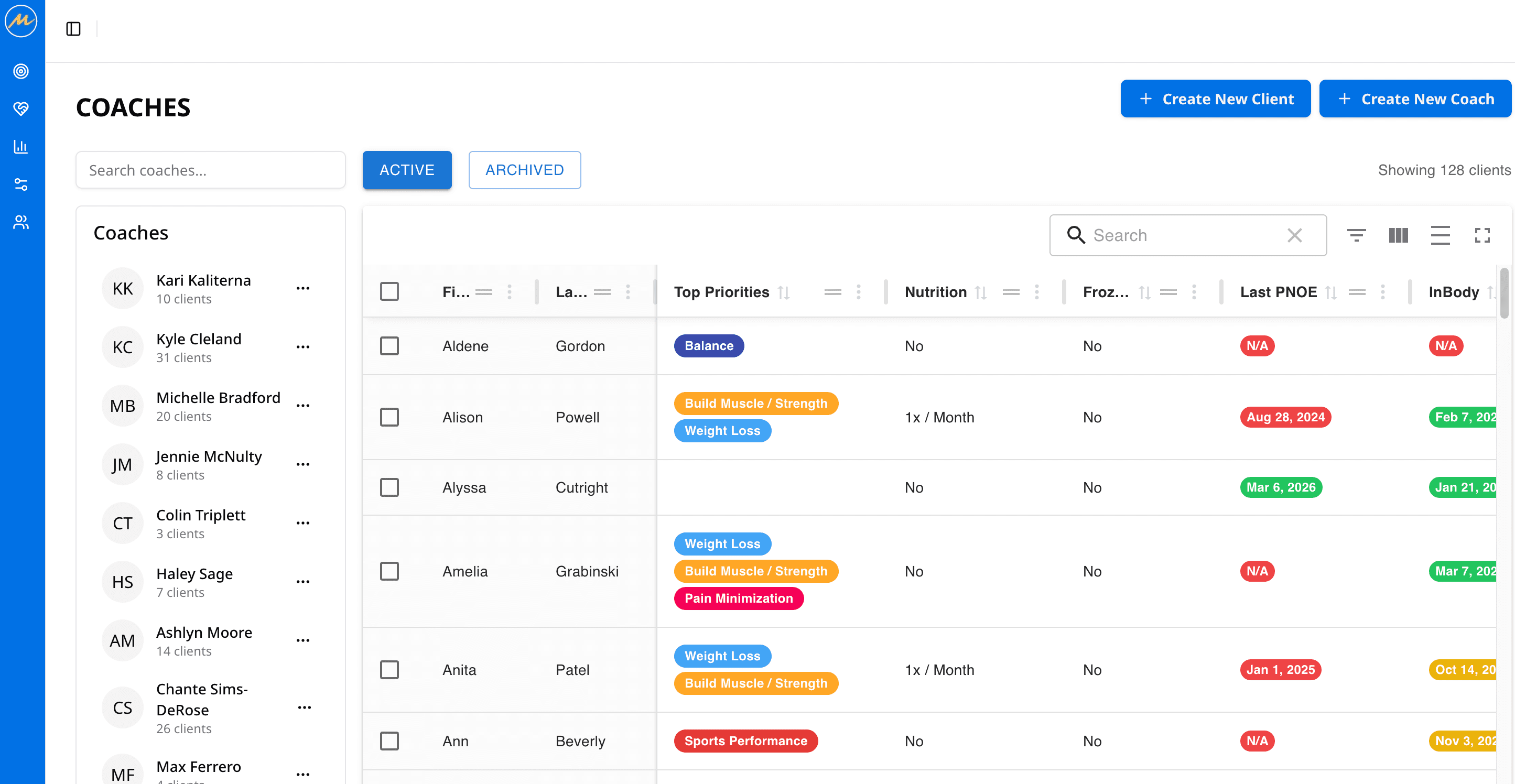
The MintFit platform is a coach-facing web application that brings client management, structured assessment workflows, AI program generation, reporting, and an AI chat assistant into one workspace.

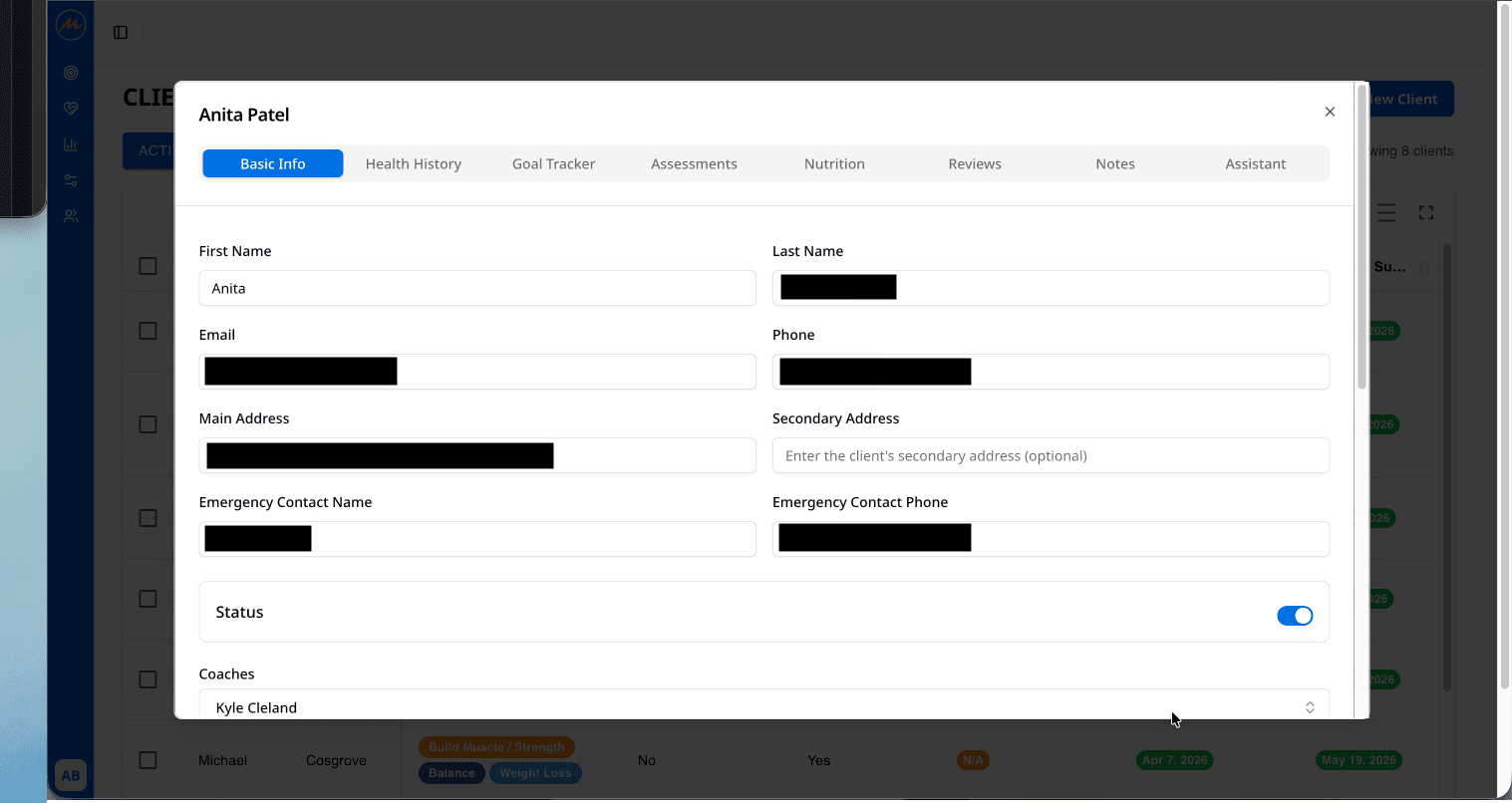
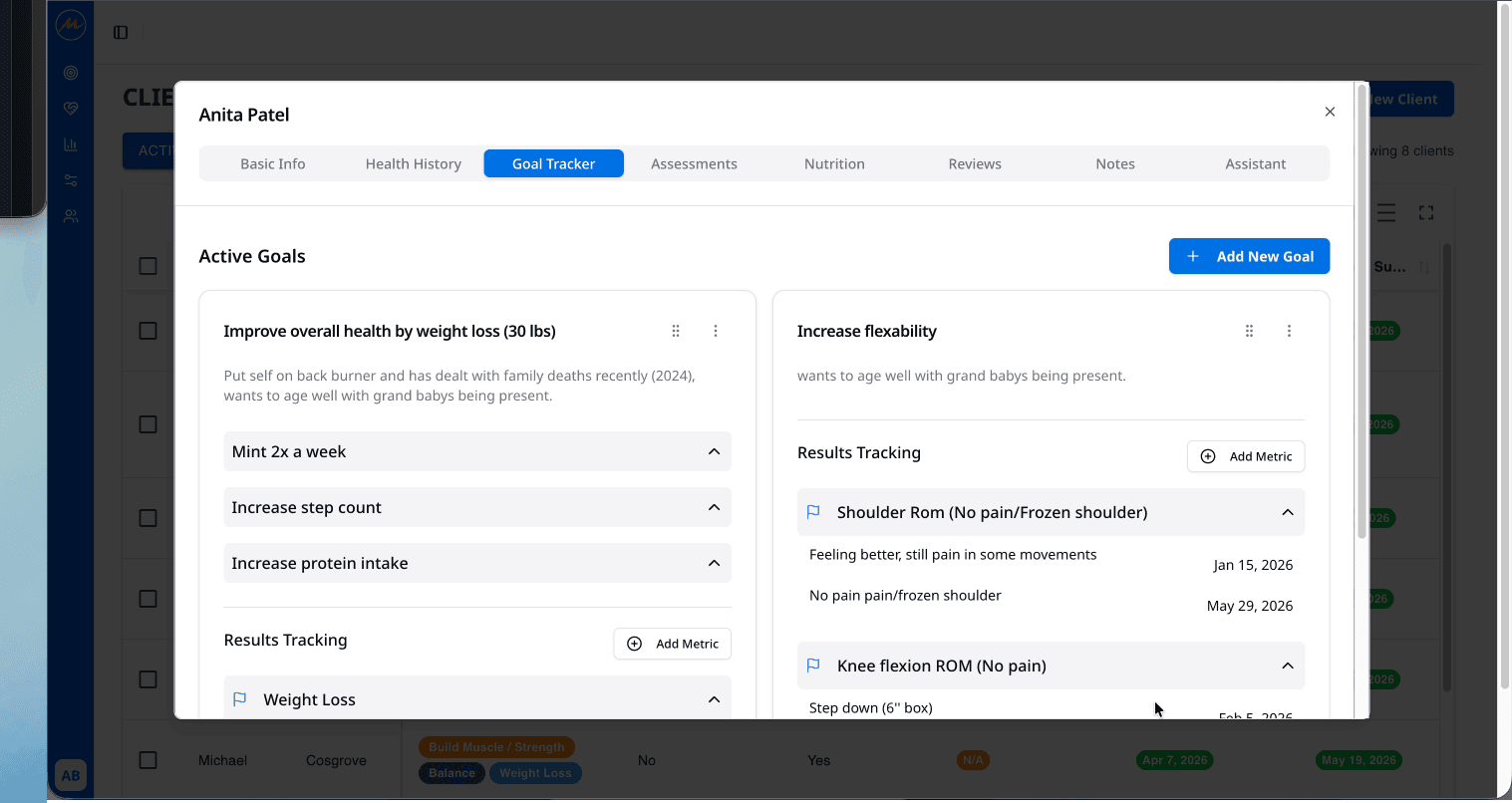
Each client has a profile combining contact information, health history, coach assignment, and status. From that same view, a coach can run a new assessment, review the historical record, generate a workout program, add notes and images, and open an AI assistant that already knows who they're working with.

The system is designed so that data layers reinforce each other. Assessment results feed the program generator. Program history informs the assistant. Notes and images are searchable and analysable. The more data goes in, the more useful every AI interaction becomes.

According to McKinsey's 2025 State of AI report (May 2025), 78% of organisations are now using generative AI in at least one business function — but the gap between organisations that deploy AI and those that derive real workflow value from it remains wide. MintFit is a clear example of the second group: AI embedded inside a structured operational system, not bolted onto the outside of one.

How We Built It

Frontend and State Management

The application is built on Next.js 14 with the App Router and React 18. The UI uses Tailwind CSS v4, shadcn/ui, and Radix UI components. State management runs on Zustand with TanStack Query for server-fetched data and TanStack Table for assessment and client list views. Forms use React Hook Form with Zod validation throughout. Charts are Recharts. The program builder uses @dnd-kit and react-beautiful-dnd for drag-and-drop session editing — coaches reorder exercises and adjust block structure after the AI generates a first draft.

AI Layer: Program Generator and Chat Assistant

The program generator is built on LangChain with OpenAI. It uses a retrieval-augmented generation pipeline backed by a LangChain memory vector store loaded with Mint Condition Fitness's own instruction documents, exercise library, and abbreviation conventions.

When a coach requests a program, the system retrieves the client's profile and assessment history, pulls methodology context from the vector store, and generates a structured warm-up, workout, and cool-down plan reflecting both the individual's constraints and the studio's way of working.

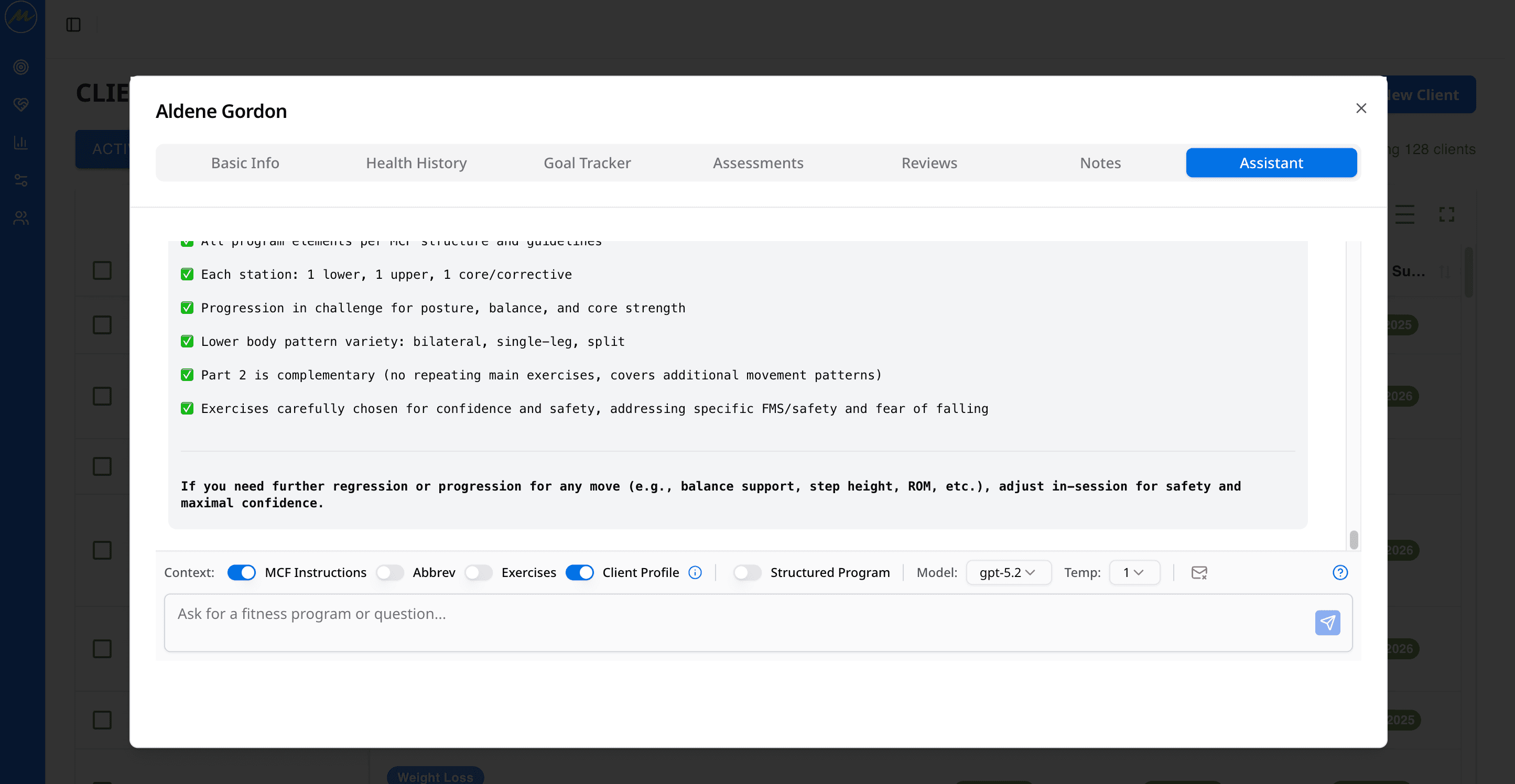
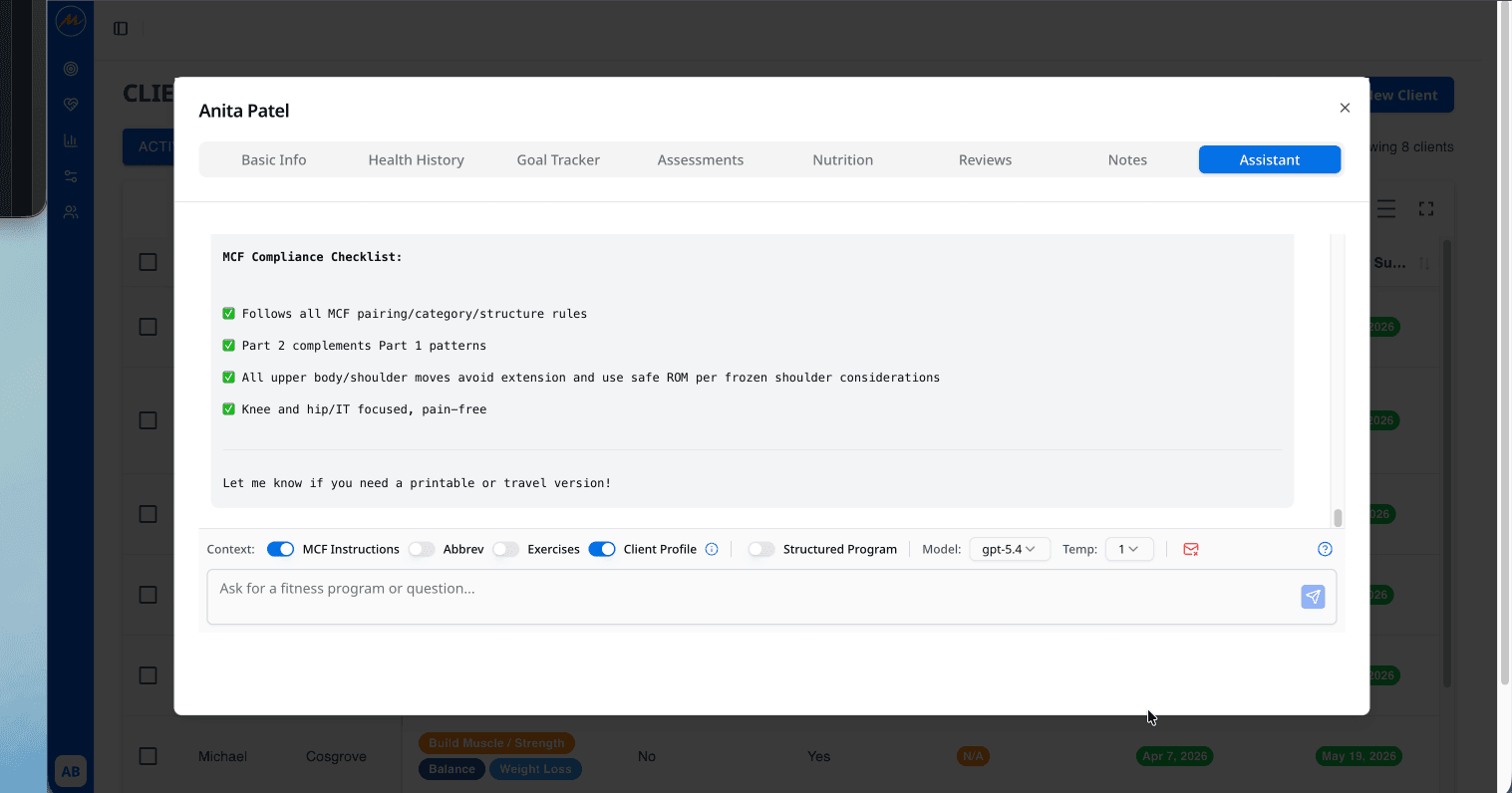
The chat assistant is built on the OpenAI Assistants API with persistent thread history per client. It's context-aware from session start, supports image analysis through Vision, and renders markdown inside the interface. Coaches use it to reason through client questions and cross-reference records without leaving the client view.

Assessment System

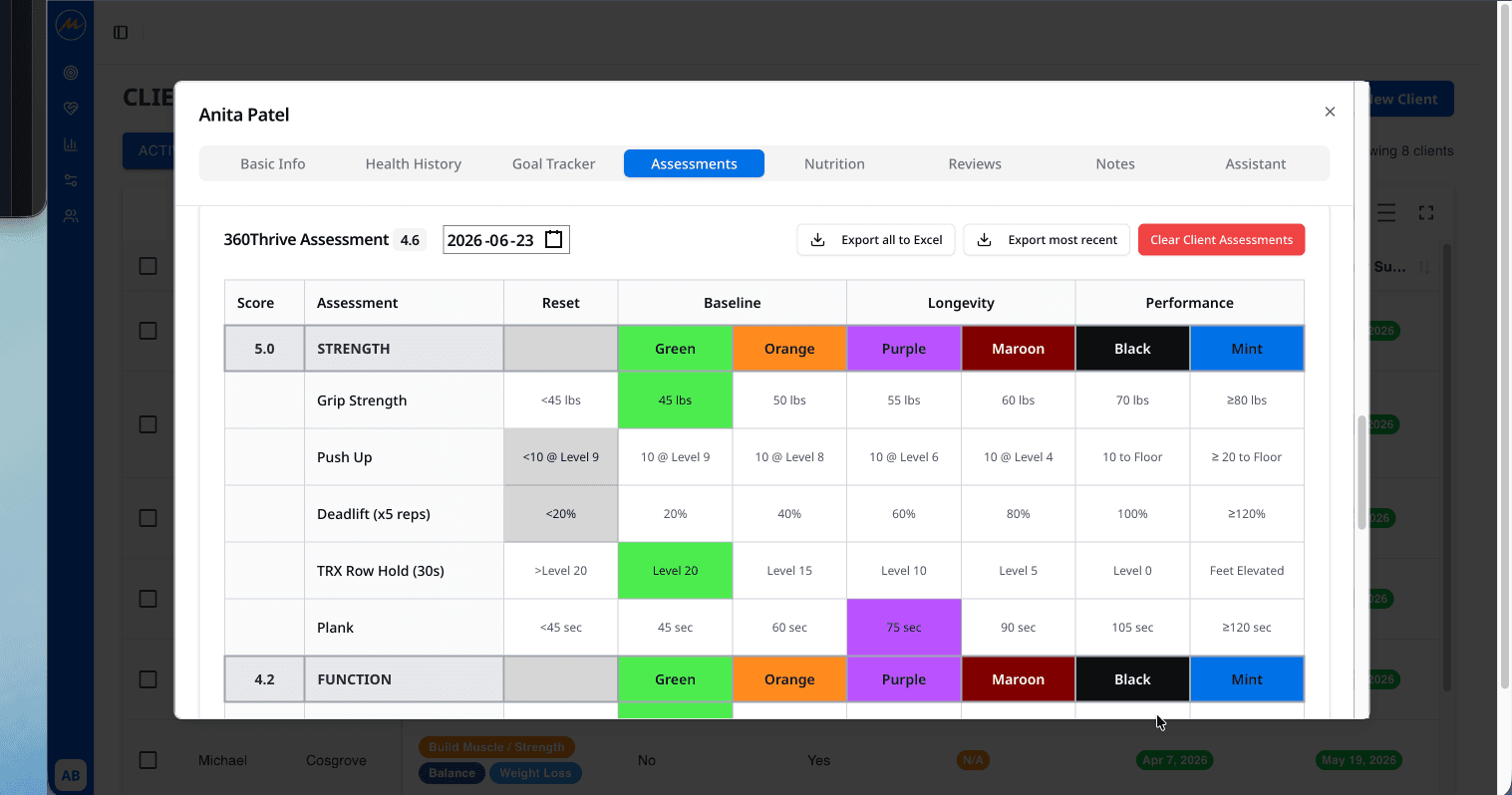
The assessment layer supports FMS, Pain Clearance Testing, SECA body composition, PNOE metabolic testing, and additional protocols through a dynamic schema-driven grid. Schemas are gender-specific where the methodology requires it. Every assessment is versioned — coaches can compare results across any time window.

Infrastructure and Auth

The backend runs on AWS Amplify with GraphQL data services, S3 file storage, and Lambda functions. Authentication is AWS Cognito with role-based access control. The admin panel manages Cognito users through Lambda. Document parsing supports Word, CSV, Excel, and PDF formats via Mammoth, PapaParse, XLSX, and Cheerio.

What Made It Hard

The Abbreviation Problem

This was the most expensive debugging session of the project.

Mint Condition Fitness coaches write in shorthand developed over 15 years: "3x10 SB RDL @2011", "FMS-cleared OHSQ pattern", "PNOE-assessed recovery threshold". When we chunked the methodology documents and embedded them, the model captured the semantic meaning of the movements — but not the naming conventions. The program generator was retrieving the right coaching context and outputting structurally correct programs, then naming every exercise in plain English instead of studio notation. Coaches couldn't use the output without manually translating every line.

Diagnosing it took sitting with the coaching team and comparing AI-generated programs to handwritten ones side by side. Once we identified the pattern, the fix required two changes: expanding all abbreviations to both their long-form and short-form representations before embedding, then applying a post-processing lookup that mapped generated exercise names back to studio convention. Implementing the fix took three days. Identifying that we needed it took another three.

Schema Complexity in Assessments

Different assessment protocols have different field structures, different scoring rules, and different gender-specific variants. Building a data model expressive enough to handle all of them — while keeping the UI fast enough for coaches to use mid-session — required multiple structural revisions. The challenge wasn't technical capability: it was resisting the pull toward a generic grid and holding out for a schema-driven approach that could handle full variation without breaking the workflow.

AWS Amplify at Its Limits

Amplify's managed GraphQL layer works well for standard data patterns. For this build, several access patterns — complex queries across client, assessment, and program history; custom Lambda-backed admin operations; fine-grained role resolution — required dropping to direct DynamoDB resolvers or custom Lambda functions. Amplify's auto-generated schema was a constraint we worked around, not through.

Context Injection That Coaches Would Actually Trust

Making the chat assistant useful in a way coaches would actually rely on required more than injecting a client profile into a system prompt. The assistant needed to surface the relevant parts of a client's history for the current question, and answer in a way consistent with studio methodology — not generic fitness advice.

The solution was a layered strategy: a structured client summary at session start, selective retrieval of relevant assessment history per query, and a system prompt grounded in Mint Condition Fitness conventions. Getting that balance right across the range of query types coaches actually used took several iterations.

What an AI Coaching Platform Actually Needs to Work

Most teams underestimate the data infrastructure required before AI is useful in a specialist coaching context. Based on the MintFit build, the minimum viable data foundation looks like this:

  • Structured client profiles — with health history, movement screening results, and risk flags encoded in a queryable format, not free text
  • Versioned assessment records — so trends are traceable over time and can ground AI-generated decisions
  • Domain-specific retrieval — a vector store loaded with your methodology, conventions, and exercise library (not generic fitness knowledge)
  • Persistent context per client — assistant threads, note history, and program history attached to the individual
  • Coach review layer — generated output is a starting point, not a final deliverable. The UI must make review and adjustment fast

Skip any of these and the AI outputs look plausible but behave unreliably. The retrieval system is what separates a useful coaching AI from a generic chatbot that happens to know about squats.

What Changed

IDC's Worldwide AI and Generative AI Spending Guide (2024) forecasts worldwide AI spending will reach $632 billion by 2028. The distribution of that spend increasingly favours purpose-built operational systems over generic AI deployments. MintFit is a small-scale example of exactly that thesis.

Program creation time dropped from 30–60 minutes per client to under five minutes for a first draft. Coaches review and adjust rather than build from scratch. Assessment data previously in spreadsheets is now searchable, time-comparable, and directly linked to program decisions. New coach onboarding changed: the methodology knowledge base in the vector store means junior coaches can query the system and get answers grounded in Mint Condition Fitness conventions, not generic internet fitness advice.

What's Next — The Roadmap

  • Client portal: self-service access for clients to view programs, progress, and coaching notes
  • Workout logging: sets, reps, weights, and per-exercise progression history
  • Stripe billing and subscription management
  • Mobile or PWA delivery for in-session client use
  • Wearable integrations: Apple Health, Garmin, Oura
  • Nutrition tracking integration
  • Automated progression rules based on logged performance
  • PDF export for programs and progress reports
  • BI dashboard for retention, adherence, coach utilisation, and revenue
  • Fine-tuned model layers trained on the studio's own programme history

The foundation is built to support all of this. Adding client-facing layers on top of a well-structured coaching backend is a materially different problem from building it the other way around.

AI Fitness Coaching Platforms — Common Questions

How does an AI fitness coaching platform generate personalised programs? In a system like MintFit, the AI doesn't generate from a blank slate. It retrieves client-specific context — assessment history, injury flags, past programs — and methodology-specific context — exercise conventions, programming rules, session structure — from a vector store, then generates a plan grounded in that retrieved data. The quality of the output depends directly on what's in the retrieval system.

What is RAG, and why does it matter for coaching software? RAG — retrieval-augmented generation — supplements an LLM's generation with information retrieved from your own data, rather than relying on what the model learned in training. For a specialist coaching studio, this is the only architecture that makes an AI reflect your specific methodology rather than generic fitness knowledge. Without RAG, the AI knows fitness. With RAG, it can know your approach to fitness.

Can AI replace a personal trainer? No — and that's not what these systems are for. The AI in MintFit handles the time-consuming operational layer: program generation, context recall, data synthesis. The coach handles the judgement layer: real-time adaptation, relationship, accountability. The system makes coaches faster and more consistent. It doesn't replace the reason clients hire them.

What's the difference between an AI chatbot for fitness and a purpose-built coaching assistant? A generic fitness chatbot answers questions about exercise based on its training data. A purpose-built coaching assistant — like the one in MintFit — is grounded in a specific client's history, the studio's methodology, and the coach's previous notes. The outputs are specific, contextual, and methodology-consistent rather than generically correct.

The interesting thing about MintFit is that the AI components — the program generator, the assistant — are not the hard part in isolation. What makes them work is the data model underneath them and the retrieval system above them. Encoding 15 years of proprietary coaching methodology into something a language model can use reliably is a problem specific to this kind of specialist deployment. Once solved, it also becomes your competitive moat.

If you're scoping an AI coaching platform or want to understand what this kind of build actually involves, explore our AI integration and automation practice or see our other real AI implementations across industries.

That operating model creates a data problem quickly. Coaches need a reliable way to manage detailed client profiles, track multiple assessment types, generate personalised workout plans, review progress over time, and keep coaching context available in one place.

For MintFit, the goal was not just to add AI for novelty. The platform needed to help coaches move faster without losing the judgement, personalisation, and accountability that make the service valuable.

What We Built

We built an AI-powered coaching platform for Mint Condition Fitness that brings client management, assessment workflows, program generation, analytics, and AI assistance into a single dashboard.

At the centre of the product is a coach-facing workspace where staff can review health history, manage client notes, analyse assessment data, generate workout programs, and interact with AI tools that understand the specific client context.

The result is a system that supports both operational efficiency and better coaching consistency. Instead of switching between scattered tools or manually rebuilding plans from scratch, coaches can work from a structured record that combines historical performance, uploaded materials, and AI-assisted recommendations.

Platform Architecture

The application is built on Next.js 14 with the App Router and React 18, using Tailwind CSS, shadcn/ui, Radix UI, and selected Material UI components on the frontend.

For state and data handling, the platform uses Zustand, TanStack Query, and TanStack Table. Form workflows are implemented with React Hook Form and Zod. Visual reporting relies on Recharts, while drag-and-drop interactions use libraries including @dnd-kit, react-dnd, and react-beautiful-dnd.

On the backend, the platform runs on AWS Amplify with Auth, GraphQL data services, file storage, and Lambda functions. Authentication is handled through AWS Cognito with role-aware access control. Uploaded assets and coaching materials are stored in Amazon S3.

The AI layer combines OpenAI models, LangChain, and LangGraph. Retrieval-backed features use OpenAI embeddings with a LangChain memory vector store so the system can generate plans and responses with real domain context rather than generic fitness advice.

Core Product Capabilities

Client Management

The platform includes full client profiles with contact information, health history, coach assignment, client status, and searchable records. This creates a single operational source of truth for each client.

Assessment Workflows

MintFit coaches work with a wide range of structured assessments, including FMS, Pain Clearance Testing, SECA, and PNOE. The system supports dynamic schema-driven input, gender-specific schemas where required, and historical progress tracking.

That matters because workout design in this context depends on more than broad goals. It depends on constraints, risk factors, movement quality, pain signals, and measurable change over time.

AI Fitness Program Generation

One of the most important capabilities in the platform is program generation. Using LangChain with OpenAI, the system generates structured warm-up, workout, and cool-down plans based on client profile data, stored instructions, abbreviations, and exercise library context.

This is not a generic prompt box bolted onto the UI. It is a retrieval-backed generation workflow designed to reflect Mint Condition Fitness methodology and coaching conventions.

AI Chat Assistant

The platform also includes an AI assistant per client, built on the OpenAI Assistants API. It maintains thread history, works with client-specific context, supports image analysis through vision models, and renders markdown and code cleanly inside the interface.

This gives coaches a faster way to inspect client context, reason through questions, and work with uploaded information without manually piecing together fragmented notes.

Notes, Images, and Reports

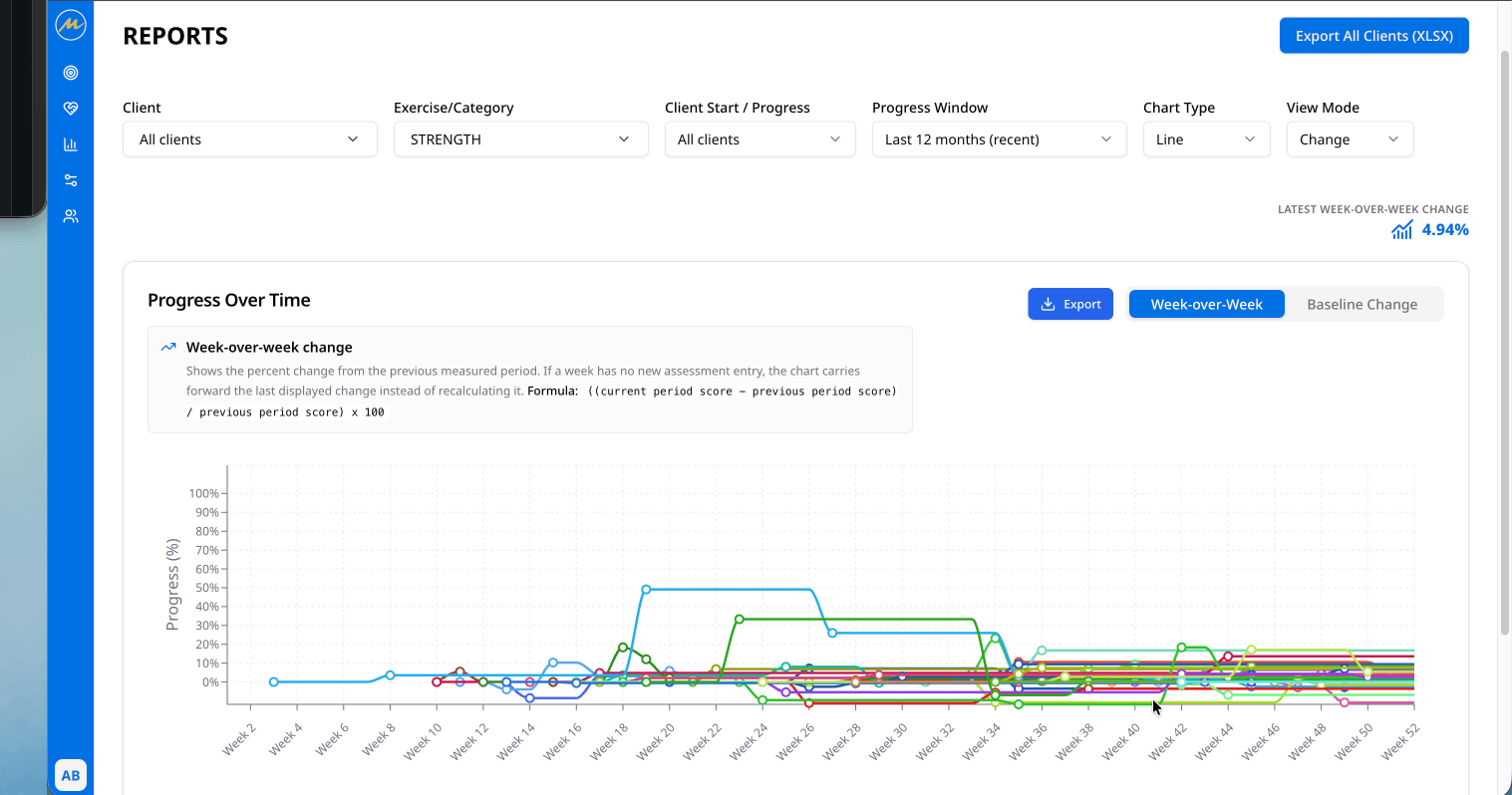
Coaches can upload notes and images to S3, pin important content, and use AI-powered image analysis where relevant. On top of that, the reporting layer provides exercise progress charts, time-window filtering, and multi-metric visualisations to make trend analysis easier.

Admin and Settings

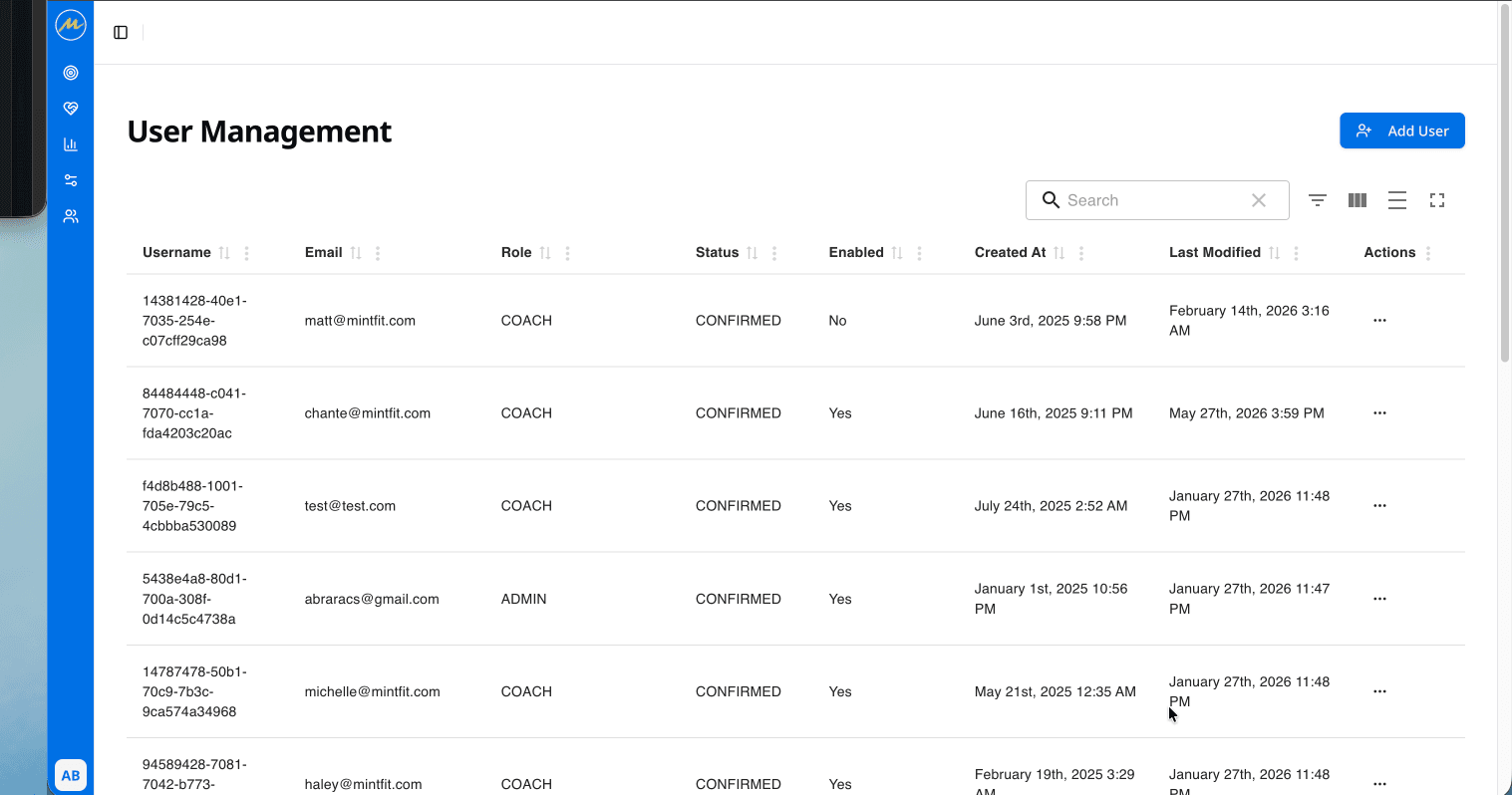
The platform includes an admin panel for Cognito user role management through Lambda functions, plus settings for column visibility, assessment help text, and model or temperature controls.

API routes support assistant workflows, image analysis, RAG operations, Word-to-text conversion, and Google Docs instruction parsing.

Tech Stack Summary

  • Frontend: Next.js 14, React 18, Tailwind CSS v4, shadcn/ui, Radix UI, Material UI
  • State and data: Zustand, TanStack Query, TanStack Table
  • Forms and validation: React Hook Form, Zod
  • Visualisation: Recharts
  • Drag and drop: @dnd-kit, react-dnd, react-beautiful-dnd
  • File parsing: XLSX, PapaParse, Mammoth, Cheerio
  • Backend and cloud: AWS Amplify, Lambda, S3, GraphQL
  • Authentication: AWS Cognito with role-aware access control
  • AI layer: OpenAI, LangChain, LangGraph
  • Retrieval: OpenAI embeddings with LangChain memory vector store
  • CI and quality: Bitbucket Pipelines, ESLint, Prettier, Husky, lint-staged

Why This Build Matters

Fitness software often breaks down when it tries to cover specialist coaching workflows with shallow templates. MintFit had different requirements: deep client context, structured assessment handling, flexible reporting, and AI that could support domain-specific reasoning instead of replacing the coach.

The platform addresses that by combining operational software with retrieval-backed AI systems. It helps coaches work faster, maintain methodology consistency, and deliver more tailored plans without flattening the coaching process into generic automation.

What Could Come Next

  • Client self-service access so clients can view programs, progress, and selected notes
  • Workout logging with sets, reps, weights, and progression history by exercise
  • Stripe-based billing and subscription workflows
  • A mobile app or PWA for client-side workout delivery
  • Wearable integrations such as Apple Health, Fitbit, Garmin, or Oura
  • Nutrition tracking and coaching integrations
  • Email and push notifications for reminders and check-ins
  • Appointment scheduling flows
  • PDF export for reports and coaching plans
  • Automated program progression rules based on logged performance
  • Batch CSV onboarding for new client imports
  • Fine-tuned model layers based on proprietary methodology
  • Business intelligence dashboards for retention, adherence, coach utilisation, and revenue
  • Offline-first or PWA support for low-connectivity environments
  • Test suite expansion with unit and end-to-end coverage

Closing Note

MintFit is a good example of where AI works best in software: not as a generic chatbot, but as part of a carefully designed operating system for specialists. The value comes from how the data model, coaching workflows, and retrieval-backed intelligence fit together into one usable product.

Written By

Abrar

Founder, AIfantry | AI Engineer

Ready to achieve similar results?

Our team of AI experts is ready to help you transform your business with tailored AI solutions.

Contact Us Today